
Showing posts with label Studio Brief 2. Show all posts
Showing posts with label Studio Brief 2. Show all posts
Friday, 11 August 2017

Theory Into Practice: Study Task 8 - Rationale
The main theme of my work is the concept of pastiche vs parody and replication vs referencing within modern contemporary practice. By this I mean to explore whether or not contemporary practice, existing in a post-modern era, simply reproduces and copies what has come before it or whether or not, despite drawing from pre-existing reference points, practitioners can establish a unique voice visually through how they choice to combine, interpret and build upon these points of reference.
The main theorists I have referenced are Walter Benjamin and Mark Fisher for their writings on the effect of technological developments on creative practice and culture. In particular I was interested in Bejamin's focus on how technological mass production had removed 'aura' from artists and their process as well Mark Fisher's notion that a post internet world had led to popular culture succumbing '...to its own inertia and retrospection.'.
To me these theories opened up a dialogue of whether or not modern contemporary practice is simply a process of blindly copying what has come before (pastiche/replication) or whether or not it is about how different points of reference are combined and built upon to create something new (parody/reference). This line of thought also led me to consider the idea of lineage and progression within the arts.
Visually I decided to explore these concepts through the use of collage, both traditional and digital. This is because, given that my project was all about the role of past work/points of reference impacting the work of contemporary practitioners I thought the re-appropriation of pre-existing iamges was the best way to explore this.
After some initial experimentation I landed upon a process of combining and altering the same set of elements within a series of pieces to create a different final outcome in each piece. This was meant to show how practitioners can draw from the same set of influences and build upon past works/points of reference to create something new and unique to them rather than simply engage in a process of pastiche.
The main theme of my work is the concept of pastiche vs parody and replication vs referencing within modern contemporary practice. By this I mean to explore whether or not contemporary practice, existing in a post-modern era, simply reproduces and copies what has come before it or whether or not, despite drawing from pre-existing reference points, practitioners can establish a unique voice visually through how they choice to combine, interpret and build upon these points of reference.
The main theorists I have referenced are Walter Benjamin and Mark Fisher for their writings on the effect of technological developments on creative practice and culture. In particular I was interested in Bejamin's focus on how technological mass production had removed 'aura' from artists and their process as well Mark Fisher's notion that a post internet world had led to popular culture succumbing '...to its own inertia and retrospection.'.
To me these theories opened up a dialogue of whether or not modern contemporary practice is simply a process of blindly copying what has come before (pastiche/replication) or whether or not it is about how different points of reference are combined and built upon to create something new (parody/reference). This line of thought also led me to consider the idea of lineage and progression within the arts.
Visually I decided to explore these concepts through the use of collage, both traditional and digital. This is because, given that my project was all about the role of past work/points of reference impacting the work of contemporary practitioners I thought the re-appropriation of pre-existing iamges was the best way to explore this.
After some initial experimentation I landed upon a process of combining and altering the same set of elements within a series of pieces to create a different final outcome in each piece. This was meant to show how practitioners can draw from the same set of influences and build upon past works/points of reference to create something new and unique to them rather than simply engage in a process of pastiche.
Theory Into Practice: Lineage
With a shift in the focus of my work I thought it would be good to try to better demonstrate this idea of practitioners coming from the same visual or conceptual starting point but ending at something completely different based upon what other experiences,references and processes they may also apply to their practice.
Therefore I experimented with producing two, five image series where by each series both starts at the same image that is gradually worked into and altered into something different. The idea was that both sets would still contain elements of the original image but would be drastically different from each other and would have reached their final form through a different set of applications.


I further tried to reinforce the concept by making the start image for both a traditional ink drawing from China that was then worked into digitally so as to show the idea of tradition and lineage and how this is referenced and altered in contemporary visual practice.
Geographical Location
So far I had only explored the idea of pastiche vs parody/ replication vs reference through the use of drawing from past influences/the work of others. However I thought it would also be worth exploring how technology has closed geographical distances as well meaning that practitioners can drawn from and reference work from all round the work to create something new.
Therefore I began creating a series of collages that combined traditional Chinese prints with drawings of Greco-Roman statues show as to show this combination of influences from different geographical locations.


With a shift in the focus of my work I thought it would be good to try to better demonstrate this idea of practitioners coming from the same visual or conceptual starting point but ending at something completely different based upon what other experiences,references and processes they may also apply to their practice.
Therefore I experimented with producing two, five image series where by each series both starts at the same image that is gradually worked into and altered into something different. The idea was that both sets would still contain elements of the original image but would be drastically different from each other and would have reached their final form through a different set of applications.


I further tried to reinforce the concept by making the start image for both a traditional ink drawing from China that was then worked into digitally so as to show the idea of tradition and lineage and how this is referenced and altered in contemporary visual practice.
Geographical Location
So far I had only explored the idea of pastiche vs parody/ replication vs reference through the use of drawing from past influences/the work of others. However I thought it would also be worth exploring how technology has closed geographical distances as well meaning that practitioners can drawn from and reference work from all round the work to create something new.
Therefore I began creating a series of collages that combined traditional Chinese prints with drawings of Greco-Roman statues show as to show this combination of influences from different geographical locations.


Theory Into Practice: Media Experimentation - Digital Collage
Having now set out on a line of investigation that I was finding far more productive than my original practical work I decided to try the same principles using digital collage. This is because as a practitioner I work mainly with digital media to produce my finished pieces, therefore I felt it appropriate to mix that aspect of my practice in 501.
Furthermore given that my initial research had focused on how technological advances had affected the production and development of art it seemed contextually relevant to produce some of my work digitally.

As with the previous pieces I began compiling a variety of different elements, such as my own own drawings, found imagery and textures into a variety of different compositions. Digital media gave me a lot more control over the process due to being able to continuously edit which pieces went where.
This gave me a far more varied set of practical experiments that I believe better represented the idea of artists/practitioners drawing from the same references but combing them with their own thoughts and process to create something dramatically different.
Although the original start point for this project was pastiche I now think it has moved more towards words such as lineage, progress and reference. This is in that my main visual argument seems to be that, although you may draw from the same influences as other practitioners and reference ideas that have already been done, you build upon them and combine them with others in a way that is unique to you.
Having now set out on a line of investigation that I was finding far more productive than my original practical work I decided to try the same principles using digital collage. This is because as a practitioner I work mainly with digital media to produce my finished pieces, therefore I felt it appropriate to mix that aspect of my practice in 501.
Furthermore given that my initial research had focused on how technological advances had affected the production and development of art it seemed contextually relevant to produce some of my work digitally.

As with the previous pieces I began compiling a variety of different elements, such as my own own drawings, found imagery and textures into a variety of different compositions. Digital media gave me a lot more control over the process due to being able to continuously edit which pieces went where.
This gave me a far more varied set of practical experiments that I believe better represented the idea of artists/practitioners drawing from the same references but combing them with their own thoughts and process to create something dramatically different.
Although the original start point for this project was pastiche I now think it has moved more towards words such as lineage, progress and reference. This is in that my main visual argument seems to be that, although you may draw from the same influences as other practitioners and reference ideas that have already been done, you build upon them and combine them with others in a way that is unique to you.
Theory Into Practice: Practical Response
After my initial research I decided to begin by creating visual representations of pastiche. This was because although I didn't know exactly where I wanted to go with project it seemed best to start with one of the key words that I had picked out from before. In particular I decided to choose pastiche due to its pertinence to my essay (although i realise this isn't simply meant to illustrate studio brief 1) as well as the writings of Benjamin and Fisher.
Naturally I felt that collage rather than drawing would be the best process to focus on visual due to the fact that the key words I had listed all involved borrowing from and re-appropriated images and ideas. Therefore I began using collage to try visually represent pastiche purposefully choosing pop culture figures such Marilyn Monroe and Jean Michel Basquiat to enforce visually this notion of copying from past artistic movements.


Breakthrough via Practical Research
Although it was a start, this felt too simple and poorly thought out to base a whole project around and I felt that it would soon become quite stale. However In the process of making this initial 'pastiche' collages I managed to move my visual research into another direction.
Given that I had wanted to try a few different compositions out with each image, I had photocopied multiple versions of the same image but applied them into different images. What this resulted in was pairs of images that, whilst being comprised of the same pieces, were drastically different in their final position.


To me this seemed to visually represent the ongoing debate that I been looking at of parody vs pastiche/replication vs referencing given that it showed how different outcomes can be made despite being sourced from the same original pieces or points of reference. Therefore i decided this process was something on which I could base the rest of my project on and see how far I could push it.
After my initial research I decided to begin by creating visual representations of pastiche. This was because although I didn't know exactly where I wanted to go with project it seemed best to start with one of the key words that I had picked out from before. In particular I decided to choose pastiche due to its pertinence to my essay (although i realise this isn't simply meant to illustrate studio brief 1) as well as the writings of Benjamin and Fisher.
Naturally I felt that collage rather than drawing would be the best process to focus on visual due to the fact that the key words I had listed all involved borrowing from and re-appropriated images and ideas. Therefore I began using collage to try visually represent pastiche purposefully choosing pop culture figures such Marilyn Monroe and Jean Michel Basquiat to enforce visually this notion of copying from past artistic movements.


Breakthrough via Practical Research
Although it was a start, this felt too simple and poorly thought out to base a whole project around and I felt that it would soon become quite stale. However In the process of making this initial 'pastiche' collages I managed to move my visual research into another direction.
Given that I had wanted to try a few different compositions out with each image, I had photocopied multiple versions of the same image but applied them into different images. What this resulted in was pairs of images that, whilst being comprised of the same pieces, were drastically different in their final position.


To me this seemed to visually represent the ongoing debate that I been looking at of parody vs pastiche/replication vs referencing given that it showed how different outcomes can be made despite being sourced from the same original pieces or points of reference. Therefore i decided this process was something on which I could base the rest of my project on and see how far I could push it.
Theory Into Practice: Initial Ideas and research
Having completed my essay entitled: 'To what extent is pastiche and inevitable and integral part of contemporary creative practice' that explored ideas of authenticity, authorship and originality within modern contemporary practice I began to think how I could explore similar themes visually.
I begun this by compiling lists of words that seemed most imported to these concepts. The most important of which seemed to me to be be:
Pastiche
Parody
Replicate
Homage
Reference
I have highlighted these words as being the most important for my initial research as half back up the idea of intentional and stagnant recycling of ideas and motifs within the arts (Pastiche, Replicate, Homage) where as the others (Parody and Reference) suggest the use of past ideas/motifs as being essential in the process of creating new works through building and taking your own stance on what has come before.
The two main theorists I was drawn when exploring these themes were Walter Benjamin and Mark Fisher.
Walter Benjamin
Benjamin's ideas relating to how mass reproduction had radically altered both how art was produced and how it was viewed seemed central to the notion on pastiche vs parody/replication vs referencing within contemporary practice. This is because it has allowed for anyone to draw influences from anywhere whilst simultaneously removing the 'aura' from contemporary arts.
What is meant by this is that the notion that art and the person who has created it is on a higher level of creative or philosophical thinking has been removed and that the process is now open to anyone as is the understanding of how work is made. Therefore it could be argued that the process of looking backward and drawing from the past has always been aprt of the artistic process but only recently in the late modern and post modern era been made obvious to the majority of society.
Mark Fisher (aka K Punk)
Much of Fisher's writing relates to how the internet has altered the way in which artistic movements begin and develop. He mainly argues that we are now living in a 'post-everything world' due to vast amount of resources and references we can now draw on due to the onset of the internet. In particular he argues that now popular culture has 'succumbed to its own inertia and retrospection'.
Having completed my essay entitled: 'To what extent is pastiche and inevitable and integral part of contemporary creative practice' that explored ideas of authenticity, authorship and originality within modern contemporary practice I began to think how I could explore similar themes visually.
I begun this by compiling lists of words that seemed most imported to these concepts. The most important of which seemed to me to be be:
Pastiche
Parody
Replicate
Homage
Reference
I have highlighted these words as being the most important for my initial research as half back up the idea of intentional and stagnant recycling of ideas and motifs within the arts (Pastiche, Replicate, Homage) where as the others (Parody and Reference) suggest the use of past ideas/motifs as being essential in the process of creating new works through building and taking your own stance on what has come before.
The two main theorists I was drawn when exploring these themes were Walter Benjamin and Mark Fisher.
Walter Benjamin
Benjamin's ideas relating to how mass reproduction had radically altered both how art was produced and how it was viewed seemed central to the notion on pastiche vs parody/replication vs referencing within contemporary practice. This is because it has allowed for anyone to draw influences from anywhere whilst simultaneously removing the 'aura' from contemporary arts.
What is meant by this is that the notion that art and the person who has created it is on a higher level of creative or philosophical thinking has been removed and that the process is now open to anyone as is the understanding of how work is made. Therefore it could be argued that the process of looking backward and drawing from the past has always been aprt of the artistic process but only recently in the late modern and post modern era been made obvious to the majority of society.
Mark Fisher (aka K Punk)
Much of Fisher's writing relates to how the internet has altered the way in which artistic movements begin and develop. He mainly argues that we are now living in a 'post-everything world' due to vast amount of resources and references we can now draw on due to the onset of the internet. In particular he argues that now popular culture has 'succumbed to its own inertia and retrospection'.
Thursday, 5 May 2016
Leeds College of Art
BA (Hons) ILLUSTRATION
|
Level
|
04
|
OUIL401 Context of Practice
|
Credits
|
20
|
End of Module Self Evaluation
|
||
NAME
|
Christopher
Cooper
|
1. What
skills have you developed through this module and how effectively do you
think you have applied them?
|
|||||
The main skill I have developed
is my essay writing and extract information in an academic manner from a
series of varying sources such as images and essays. Given that I haven't
written an essay since sixth form I felt a little rusty in terms using the
academic process therefore I found it highly useful if not stressful at times
putting together a fully referenced essay with an underlying and coherent
thesis.
|
|||||
2. What approaches to/methods of research have you
developed and how have they informed your practical outcomes?
|
|||||
Given that there was no final
outcome I have developed an approach whereby I let research and think take me
down various different avenues, some unexpected and useful others of which
are complete dead ends. This allows for a more over arching visual
exploration of I given theme and for connections to be drawn between different
areas that you otherwise would not have been able to make.
|
|||||
3. What strengths can you identify in your work and
how have/will you capitalise on these?
|
|||||
I think the relationship between
my intent for studio brief 2 that and the work itself was probably my
strongest point. This is because I feel it very clearly and effectively
communicated my underlying theme of conformity that I had set out in my visual
response proposal. This was partly due to the variety of different methods I
used with a reductive process of repeat image making being the most
successful. Furthermore the research I conducted into different forms of conformity
and the scientific thinking behind it greatly informed the images which no
doubt led to their effective communication of the given theme.
|
|||||
4. What weaknesses can you identify in your work
and how will you address these in the future?
|
|||||
My main weakness was my lack of consistent
blogging coupled with a lack of varied and in depth research for studio brief
2. For example, although I read and referenced a fair amount of material for
studio brief 1 had a blogged all the different sources as I went along I
think my final result would have been far better constructed and thoughtful
in its argument. In a similar manner had I undergone a wider variety of
research for studio brief 2 I think the successes that I did achieved would
have been furthered and led to a much more interesting and varied visual
response.
|
|||||
5. Identify five things that you feel will benefit
you during next years Context of Practice module?
|
|||||
Blogging
more consistently and in particular blogging any academic sources and any
subsequent deconstruction of them on my part.
Being more
varied and ambitious in my forms of research which will lead to more
interesting and excting results with stronger factual grounding.
Better
spread the work load over the year so that it isn't as stressful and in turn
can allow me to better think through what it is I am trying to achieve with
this module.
The importance
of choosing a subject you are interested in. Although I could have researched
it more effectively I was genuinely interested in the underlying theme of
conformity in studio brief 2 which resulted in me being able to immerse
myself in the process of a visual response much more effectively.
The academic
process, particularly deconstructing and analysing texts effectively to
support your argument through the use of triangulation, paraphrasing and
close reading as these are the fundamental skills required to produce an
effect and coherent academic thesis.
|
|||||
6.How would you grade yourself on the following
areas:
(please indicate using an ‘x’)
5= excellent, 4 = very good, 3 = good, 2 = average,
1 = poor
|
|||||
1
|
2
|
3
|
4
|
5
|
|
Attendance
|
X
|
||||
Punctuality
|
X
|
||||
Motivation
|
X
|
||||
Commitment
|
X
|
||||
Quantity of work produced
|
X
|
||||
Quality of work produced
|
X
|
||||
Contribution to the group
|
X
|
||||
The evaluation of your work is an important part of
the assessment criteria and represents a percentage of the overall grade. It
is essential that you give yourself enough time to complete your written
evaluation fully and with appropriate depth and level of self-reflection. If
you have any questions relating to the self-evaluation process speak to a
member of staff as soon as possible.
|
|||||
Resolved images


 Although it was intentional, I think the images feel perhaps a little too boring and monotonous, looking back at what worked within my visual journal I tried to keep this feeling but create some interest by adding texture on photo shop to the vectors. To do this I created various ink and paint textures, scanned them in and converted them using the half tone bitmap tool as I felt this would give a more digital aesthetic which would better tie into the underlying themes of the images.I think this has successfully added a bit more interest to the images due to how the textured shapes alongside the flat vectors break up and add another level of contrast to the images. However I still feel the top two are far better than the bottom one as it still feels some what boring even though I think it is much clearing in communicating the subject matter or people sleeping on trains.Although aesthetically it's my favourite the first image feels perhaps a little too surreal and isn't quite as clear as the other two in communicating its intent. I think this is in part because the other two use motifs that clearly reference and relate to the ideas of the commute and the daily gring of a nine until five job.


Given the problems faced in achieving the sense of visual uniformity that I wanted from my images I decided to further develop and ultimately resolve my Japanese commuter images digitally. Initially I did this by creating them using vectors as given my images up until this point have been fairly reductive and shape based I felt the process would fit well. Furthermore contextually the cold, mass produced feel that vectors so often have I felt would further reinforce my themes and ideas for this module.


I feel that, despite the initial designs in being better for the bellow image and worse for the top two, the reverse is true for the final outcomes. This is because it feels so much flatter given that it doesn't have the same sense of depth/space. I Tried to resolve this by adding a row of passengers with their backs to the viewer to give the impression of a full train car, however I still don't think it has quite worked.
 Although it was intentional, I think the images feel perhaps a little too boring and monotonous, looking back at what worked within my visual journal I tried to keep this feeling but create some interest by adding texture on photo shop to the vectors. To do this I created various ink and paint textures, scanned them in and converted them using the half tone bitmap tool as I felt this would give a more digital aesthetic which would better tie into the underlying themes of the images.I think this has successfully added a bit more interest to the images due to how the textured shapes alongside the flat vectors break up and add another level of contrast to the images. However I still feel the top two are far better than the bottom one as it still feels some what boring even though I think it is much clearing in communicating the subject matter or people sleeping on trains.Although aesthetically it's my favourite the first image feels perhaps a little too surreal and isn't quite as clear as the other two in communicating its intent. I think this is in part because the other two use motifs that clearly reference and relate to the ideas of the commute and the daily gring of a nine until five job.


Visual Response: Japanese Commuters

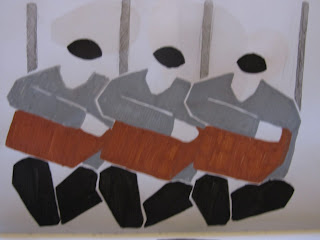
After my further researching into communicating and the 'daily grind' I decided to do I series of images based off of the idea of commuters sleeping on trains in Japan. In All the images I wanted to use a very minimal pallet consisting of primarily greys and black with the only colour being used to describe the skin. This was so that, when coupled with the use of repeat imagery, it would create much more monotonous and dreary images that better reflect the theme of conformity.

I think I have managed to achieve this feeling in these images although to varying degrees of success. I think the best is the image above, this is due to the process of collage used which, as I have said before fits in to the theme of conformity given how it allows for more accurate duplicates of the individual figures to be created. Furthermore I like how the use of Texture on the figures arms and faces add some interest two and break up other wise flat shapes.


Although I like the basic composition of them, particularly the bottom one's use of a vanishing point to create a sense of depth, the bottom two images are far less effective than the first one. This is due to the lack of accuracy between each duplicate within the individual images. Therefore I want to recreate these, and similar images digitally using both Photoshop and Illustrator in order to achieve more uniformity within the images.
Artist Research: Eleni Kalorkoti


I decided to look into more illustrator and designers with a reductive approach to creating figurative images. I was drawn to Kalorkoti's work, particularly her 'Glitch' due to her use of a drab, dreary grey scale pallet as well as the use of repeat/cloned motifs and figures. The sense of monotony this creates within the images is something I want to harness within my resolved images and which I will hopefully achieve through the further use of the more reductive shape based figures I have been creating up until this point.
Commuting: Further research


Taking in to mind what was said in the crit I decided to further my research into and visual exploration of commuting within modern societies. When I revisited this topic I became fascinated with the culture of sleeping during commutes in Japan. Although you may see some people asleep on trains or buses in England it is not very common given that most people would be far too fearful, both of those around them and missing their stop. Whereas in Japan it widespread and not uncommon to see whole train cars of sleeping passengers.
After looking online more thoroughly I discovered a few reasons, all of which link back to ideas of social compliance and conformity, for why this is such a common place thing in Japan.
Firstly crime rates are extremely low in Japan, therefore there isn't the same sense of fear that one might feel when sleeping on a train in England. This relates back to ideas of compliance as it implies that the law is taken much more seriously by more or less all members of society.
Second is the fact that many, particularly within Tokyo, commute and work very long hours and subsequently are so tired that it only makes sense they fall asleep. Therefore this shows how far people are willing to go, in this case the point of losing sleep or time at home, in order to conform to the notion of stable job and active place within society.
However I have also seen it suggested that, with the above point in mind, it is not just something practical in terms of gaining lost sleep but now something of a social convention in that if you are not seen to fall alseep during your commute you won't be considered as hard working or dedicated as other members of society. This final point more than any links back to the notion of conformity and compliance given that it makes individuals act in a irrational manner due to social pressures and expectations.
Final Crit
The general consensus from the final crit was that the use of repeated visual motifs was very successful in communicating the intent of my visual response to Studio Brief 2. In particular I was told the reductive approach to figure and form is something I should further explore and refine with regards to creating some more resolved images.
As I have already mentioned in the previous post, it was also suggested that I try achieve this digitally given the precise uniformity I would be able to achieve with it. Also with regards to final, resolved images it was suggested I work in monochrome/grey scale to achieve this dreary sense of monotony.
Conceptually it was argued that my most interesting tangent, even though it is only briefly touched upon is the one exploring the notion of commuting and working a nine until five job given its direct relevance to us and just how accepted a notion it is within society.
Visual Response: Does Non Conformity exist?
Given my focus on conformity and and compliance I thought it would be worth exploring whehter or not truly non conformist behaviour given how strong the evidence is that we inherently pre disposed to conformist group behaviours.
It has been argued that as you age you become less conformist which makes sense as when you are younger, particularly during teenage and adult years, there is for most an on going anxiety relating to fitting as well as an ongoing fixation with notions of what is or isn't cool.


The part of this I find interesting is that, despite the conformity which it results in, many people belonging to this age group choose to adopt and comply to certain lifestyles and cultures in attempt to give themselves a unique or conformist identity. This irony is explored in both a Nation of Rebels by Joseph Heath and Andrew Potter as well as by Naomi Klein in No Logo, both of which argue that this desire of the youth to rebel and be different is now some thing which brands can directly market and appeal to.
Therefore I created a series of figures that, when put next to each other appear very different and unique, as would many teens belonging to particular sub groups and niches. However to highlight how this in itself can be a form of social compliance I then created several images compositing of the just one of the supposedly unique figures repeated again to demonstrate this.


However I wasn't overly pleased with the aesthetics of these images and felt that the meaning was some what convoluted. Therefore I decided to bring my approach back to the idea of reductive image making that I have highlighted both in my artist research and previous visual responses.
With this in mind I created a series of collages, two of which were figurative, although very reductive in their description of the human form, with the rest being much more abstract. Although I prefer how the abstract ones look due to their much more balanced compositions as well more interesting textures I feel that the above figurative images communicate the idea of an individual trying not to conform and instead stand out from a crowd a lot better. Although as a metaphor I do quite like the idea of one shape breaking the mould and not fitting in with the uniform squares in the bottem image.
I felt this process much better firtted the theme conformity as it alowed me to create exact replicas of the motif I wanted to repeat given that I could simply draw round the first image, cut it out and repeat the process. I could see this process transferring well onto screen through the use of, for example, vectors.


Artist Research: Reduction, repetitive imagery


Adrian Johnson


Geoff McFetridge
Given my previous visual explorations and various different themes and feelings I am trying to achieve through curating a certain aesthetic I wanted to look at other artists that work in a reductive manner often using repetition to create graphic pattern like images despite being primarily figure based. Immediately the work of Adrian Johnson cam to mind as well as that of Geoff McFetridge. I really like just how graphic both, are in describing the human form reducing it down to its most basic elements. This is something I have already been trying within my own work but feel could be taken further.
Although I think Johnson's subject matter is perhaps a bit more cheery and positive than what I am exploring I feel McFettridge's work fits in a lot better thematically. This is due to the weird uniform tasks often being under taken within his images as well as a focus on areas of structured order and compliance such as classrooms and school yards.
Adrian Johnson
Geoff McFetridge
Visual Development: Change in approach


Given my previous developments I decided to produce a series of images in a much more reductive and shape based manner depicting large scale crowds of individuals conforming to the activities of others much like in the various sourced images. This has resulted in a series of much more uniform and hypnotic images with a more abstract, pattern like visual aesthetic which I had outlined in my previous post.
I think it was also effective conceptually to make the images very monotonous in there appearance, depicting very mundane every day tasks that solely tasks such as queuing that are utterly reliant of social compliance. This monotonous feel I tried to further exaggerate by using mainly greys and blacks as well as further abstracting the images to basic shapes and leaving negative space to describe certain features. This I feel has once again furthered the idea of individual thought/independence and in essence autonomy being over ruled by our pre disposition to conform to a group.


With all this considered I then desired to explore other mundane activities as the every day commute to work/education. I think this in particular could be a good avenue to explore as, despite its dreary, monotonous nature than many complain about, it is something that more or less or members of society engage. Therefore it is interesting to how, despite the importance we give it, the idea of a 9-5 job is some thing once again based upon ideas of both compliance and integration given our inherent needs to both fit it and be accepted as well as have our own place and function within society.

Wednesday, 4 May 2016
Further Visual Development: Contemplating a new approach


Given the points highlighted in my last post I decided to further explore the use of repeat motifs/characters to explore the theme of conformity. I tried in some way to reconcile the two sets of images I produced before by depicting a singular figure splitting in two over and over again until a whole crowd of identical clones are present. I also intentionally excluded certain features form them, such as the eyes. This was both aesthetically so as to create something simpler and bolder as I had found that was far more effective in my previous images and conceptually I think it helps play into the idea of individuals' 'blindly' following the masses.


Although I think they're successful in communicating the themes of my visual response I think the the need for simplicity I highlighted in my previous post could be taken to much further and more graphic extremes. I think much simpler, shape based image, coupled with the use of repeated elements would be a lot stronger visually and would also reinforce the conceptual themes as the idea of something 'human' and individual would be lost to a more abstract, repetitive pattern.
To furhter my ideas with this I decided to gather together a collection f images exploring large scale, uniform groups of people engaging in activities that require some level of conformity through compliance.
Initial visual responses


My initial visual responses focused mainly on the findings of Asch's experimented coupled with some of the themes of my essay that explored how young adults and teens seek trends in order to fit in and establish and excepted identity both of which are examples of compliance in action.
Therefore I went about creating a series of characters that have all merged into one homogeneous form due to how each member of the group has adopted the the thought, actions and appearance of the other in order to fit in and be accepted. Visually I think they are successful in communicating the main themes of my visual response. However I think the top two, particularly that on the right are much more successful aesthetically, as they are simpler in there constructing and bolder in their use of contrasting tone which has resulted in much more balanced images.


Ralph Steadman
Given his reputation as something of a maverick often prone to satirising and attacking various cultural and political institutions that are present within western society I decided to take out the book: Gonzo The Art by Ralph Steadman. Visually I felt it fitted with the looser more comical style of ink based drawing I had used for my initial responses. However it was his images relating to conformity and consumerism, particularly those using repeat motifs that I was drawn to. I think this is something that I could bring into my own work as it very strongly conveys the theme of conformity and compliance.
With this in mind I did some very quick drawings incorporating the use of repeat motifs, however here rather than just try and show a compliant group of conformist as I had previously done, I wanted to try and show the individual being pressured to conform. Therefore I did one figure in each image in colour with his eyes open to signify him as an individual that is 'awake' with some sense of independence. However I purposefully gave them both panicked/confused looking expressions so as to try and convey that he is being pressured into the dull monotony of the others.

Subscribe to:
Comments (Atom)